
Winnipeg & surrounding municipalities
Dehumidifier Installation
Once a crawlspace is sealed, something has to hold humidity at target through a humid Manitoba summer. We size the unit to the actual space, give it a permanent drain, and set it to a measurable target rather than a dial position.
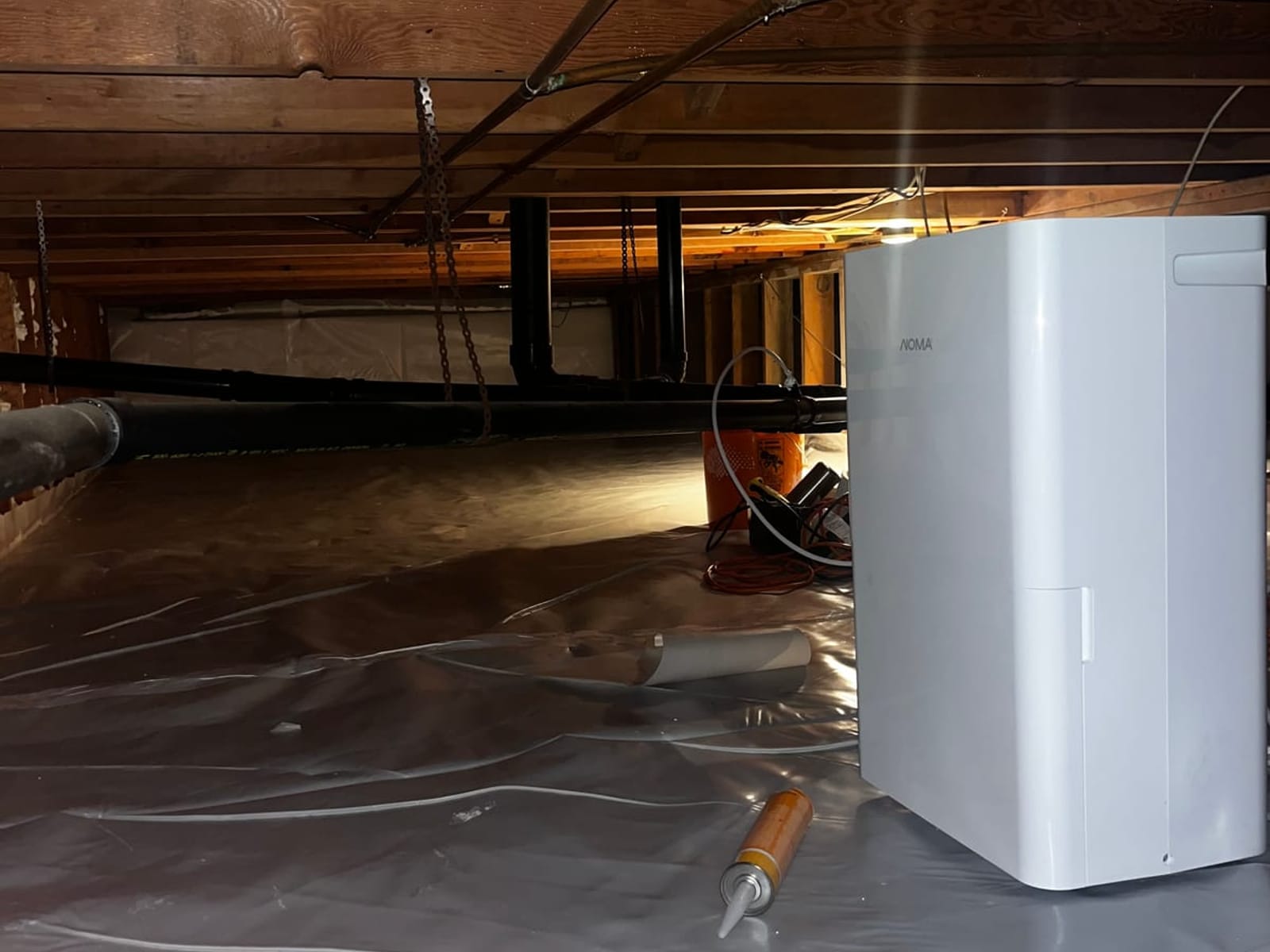
A dehumidifier is the active component of a sealed crawlspace. Encapsulation stops moisture entering from the soil and outdoor air, but it does not remove moisture already in the space, moisture that arrives with the small amount of air exchange any house has, or moisture released by a concrete slab or damp soil during the first months after sealing. Holding relative humidity in the 50 to 55 percent range keeps wood moisture content well below the threshold where decay and mould can establish, and that requires equipment rather than hope.
Sizing is where most installations go wrong in both directions. An undersized unit runs continuously, never reaches target, and wears out early. An oversized unit short-cycles, which is inefficient and does a poor job of actually controlling humidity. We size from the volume of the space, the condition of the envelope after sealing, the expected moisture load and the summer design conditions here, and we specify units built for crawlspace service — rated to operate at the cooler temperatures a crawlspace sees, and able to work against a modest duct run if the unit sits in a more accessible location.
The drain is not a detail. A unit with a bucket will be emptied conscientiously for about a month, then forgotten, and after that it is an expensive decoration. Every unit we install gets a permanent drain: gravity to a sump or an appropriate drain where the fall allows it, or a condensate pump where it does not. In our climate we also think about where that condensate goes in winter, because a line routed somewhere that freezes will back up. These are the details that determine whether the system is still working in five years.
Controls and monitoring come next. A dehumidifier controlled by a dial marked low-medium-high gives you no information. We set up control to a humidity target with a sensor in the space, and where the homeowner wants it, remote monitoring so you can see the crawlspace humidity without going down there. That matters because a crawlspace is the one part of a house nobody visits, so the first sign of a failed dehumidifier is usually a smell or visible mould months later. A reading you can check from your phone closes that gap.
Occasionally a dehumidifier is not the right answer. In some sealed crawlspaces, supplying a small amount of conditioned air from the home's heating and cooling system, with a return path, holds humidity adequately and avoids a separate appliance. Whether that works depends on your mechanical system, the size of the space and code requirements in your jurisdiction, so it needs to be assessed rather than assumed. And in a space that is still taking liquid water, no amount of dehumidification will help — drainage comes first, always.
Placement and air movement inside the crawlspace affect performance more than homeowners expect. A unit tucked into one corner of a long, divided crawlspace will hold that corner at target while a far bay sits ten points higher, which is exactly where mould appears. Where the geometry is awkward — multiple bays, interior foundation walls, bulkheads — we either locate the unit centrally, duct it to draw from and supply to the far areas, or add a small amount of air circulation so the space behaves as one zone. Measuring humidity at more than one point after commissioning is how you find out whether it actually does.
Filter maintenance is the one task that falls to the homeowner, and it is worth knowing before you commit to a unit. Crawlspace dehumidifiers pull air through a filter that loads with dust, and a blocked filter reduces capacity and makes the unit work harder. Most need checking a couple of times a season during the months they run, which means the unit has to be reachable. We will not install equipment in a position where servicing it requires crawling fifteen metres on your stomach, because equipment that is awkward to maintain does not get maintained.
Expected service life and replacement planning are worth discussing up front. A quality crawlspace dehumidifier run seasonally should give many years of service, but it is a refrigeration appliance with a compressor, and it will eventually fail. When it does, the failure is silent in a space nobody visits — which is the argument for a humidity sensor you can read without going down there. Plan for replacement rather than being surprised by it, and keep the barrier detailing around the unit serviceable so a swap does not mean cutting open the envelope.
What every project includes
- A documented inspection with moisture readings and photographs before any scope is proposed
- An itemized written quote — you can see what each part costs and defer what can wait
- Materials specified for Manitoba conditions, not a standard national package
- Readings taken again after completion so the result is measurable
Questions we get asked
Dehumidifier Installation: the practical answers
By location
Dehumidifier Installation where you live
Soil, groundwater and housing age change across the region, and so does the right approach. These pages cover what this work involves in each community.
- Winnipeg
- Headingley
- East St. Paul
- West St. Paul
- St. Andrews
- Selkirk
- Stonewall
- Stony Mountain
- Oakbank
- Dugald
- Beausejour
- Lorette
- Île-des-Chênes
- St. Adolphe
- Niverville
- Steinbach
- Landmark
- La Salle
- Grande Pointe
Winnipeg neighbourhoods
River Heights · Crescentwood · Tuxedo · Wolseley · West Broadway · Osborne Village · Fort Rouge · Lord Roberts · Riverview · St. Vital · Norwood · St. Boniface · Windsor Park · Southdale · Island Lakes · Royalwood · Sage Creek · St. Norbert · Fort Richmond · Fort Garry · Linden Woods · Whyte Ridge · Bridgwater · Waverley West · Charleswood · Westwood · Crestview · Silver Heights · St. James · North Kildonan · East Kildonan · Elmwood · Transcona · West Kildonan · Garden City · The Maples · Point Douglas · Tyndall Park
Related work
What usually goes with this
Crawlspace work comes in sequences. Drainage before sealing, structure before insulation — these are the services that most often share a scope with dehumidifier installation.
- 01 Crawlspace Encapsulation Seal the space off from soil moisture, soil gas and outside air, then keep it conditioned year-round. Details
- 02 Vapour Barrier Installation The sealed membrane that stops ground moisture and soil gas from entering your home. Details
- 03 Mould Remediation Safe removal of mould growth in crawlspaces, with the moisture source corrected so it does not return. Details
- 04 Crawlspace Insulation Perimeter wall insulation detailed for Manitoba winters, not batts falling out of the floor joists. Details
- 05 Rodent Proofing & Pest Exclusion Sealing the entry points mice and other pests use to get under your floor, and cleaning up what they left. Details
- 06 Sump Pump Installation Pumps and discharge lines specified for spring melt volume and winter freeze resistance. Details