
Winnipeg & surrounding municipalities
Crawlspace Encapsulation
Encapsulation closes your crawlspace off from the ground and the outdoor air with a continuous sealed membrane, perimeter insulation and controlled humidity. In Manitoba it is the difference between a space that cycles between frost and condensation and one that stays dry at minus 30 and plus 30.
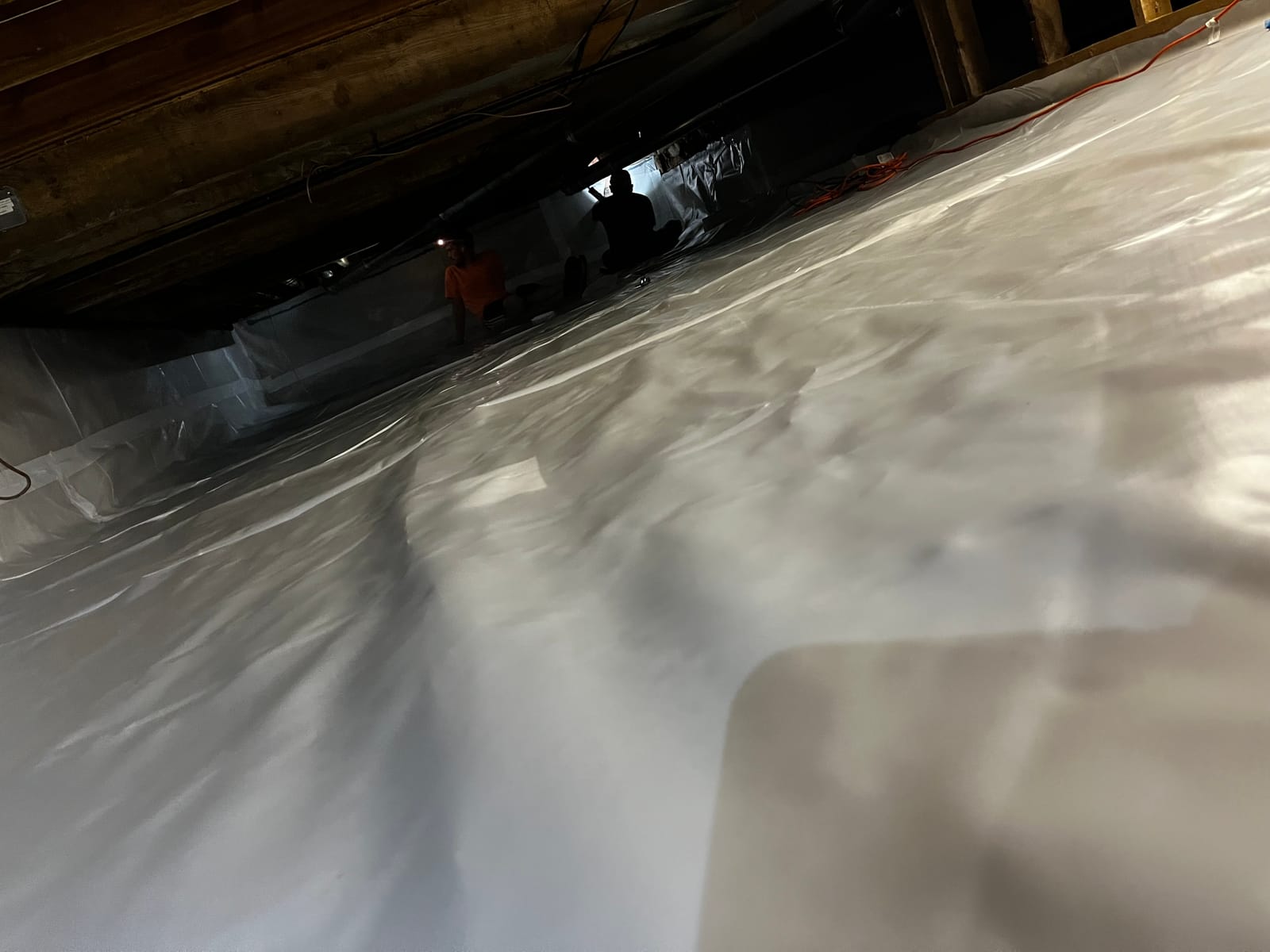
Crawlspace encapsulation means building a continuous, sealed envelope between your home and the ground beneath it. A reinforced polyethylene membrane — we specify 12-mil as a minimum and 20-mil where there will be foot traffic or sharp aggregate — is laid across the soil floor, carried up the foundation walls, mechanically fastened and sealed at every seam and penetration. Vents are closed and sealed from the inside. Insulation moves from between the floor joists to the perimeter wall, so the crawlspace joins the heated envelope of the house instead of sitting outside it. Humidity is then held at a stable target, usually in the 50 to 55 percent range.
The reason this matters so much in Winnipeg is that our climate attacks a crawlspace from two directions in the same year. In January, an unconditioned, vented crawlspace runs close to outdoor temperature. Warm, moist air from the living space moves down through the floor and condenses or frosts on the cold underside of the subfloor and on cold rim joists. In July, the direction reverses: humid outdoor air enters through the vents, hits soil and framing that are still cool, and condenses there instead. Either way the wood stays wet, and wood that holds above roughly 19 percent moisture content supports rot and mould.
Encapsulation also addresses something many homeowners here have never considered: soil gas. Manitoba records some of the highest indoor radon concentrations in Canada, and a crawlspace with bare or poorly covered soil is the most direct entry route into a house. A properly sealed and fastened membrane is the foundation of any radon strategy, and in homes with elevated readings it becomes the sealed layer that an active sub-membrane depressurization system draws from. Sealing the floor does double duty — it stops both water vapour and soil gas.
A real encapsulation is not a sheet of poly thrown on the dirt. The membrane must be continuous, with seams overlapped and taped on both faces where the material allows. It has to be carried up the walls and terminated with a mechanical fastener and sealant, not just tucked behind a rock. Piers and columns are wrapped individually. Plumbing, electrical, well and septic penetrations are sealed with foam and compatible tape. Any dehumidifier gets a permanent gravity drain or a condensate pump, because a unit draining into a bucket stops working the first month nobody empties it. Shortcuts at any of these points leave a bypass that undoes much of the benefit.
Before we encapsulate anything, we establish that the space is not taking liquid water. Sealing a crawlspace that still receives groundwater during spring melt just traps the water inside the membrane, where it is harder to find and does more damage. If the inspection shows an active water path, drainage and a properly discharged sump go in first. Once the space is dry and sealed, the results are measurable within weeks: framing moisture content drops, the musty smell in the house above disappears, the floor over the crawlspace stops feeling cold in winter, and the furnace stops working to heat a space that was open to the outdoors.
The mistakes we find in previously encapsulated crawlspaces are consistent enough to list. The membrane stops at the base of the wall instead of being carried up and terminated, so soil moisture simply travels around the edge. Seams are overlapped but taped on one face only, which fails the first time anything moves. Vents are covered on the outside with foam board rather than sealed from inside, so they still admit air. The dehumidifier drains into a bucket. Insulation was left in the floor joists, so the space stays cold and the barrier is holding back vapour from a surface that is still below the dew point in summer. Each of these is individually small, and together they are why a homeowner can pay for an encapsulation and still have a damp crawlspace two years later.
On a typical project we work in a defined order and tell you in advance what each day involves. Day one is clearance and assessment with the space fully exposed. If structural repair or drainage is in scope, that happens next, because both involve excavation and cutting that would destroy a finished barrier. Then the floor is graded where it is uneven enough to leave low spots under the membrane, the barrier is installed and sealed, piers are wrapped, and penetrations are detailed. Perimeter insulation and rim joist air sealing follow. Humidity control is commissioned last, with its drain run and tested. We photograph each stage, partly for your records and partly because once the barrier is down, most of what we are documenting is no longer visible.
Maintenance afterward is minimal but not zero. Once a year, ideally in early spring before melt, the space is worth opening: confirm the sump runs and the discharge line is clear, check the dehumidifier is cycling and draining, look along the barrier terminations for anything that has worked loose, and check the access hatch still seals. Twenty minutes. Keep stored items in sealed plastic bins rather than cardboard, and keep a clear path to the sump and any structural posts so the space can still be serviced. If you ever have plumbing or electrical work done in the crawlspace, ask the trade to tell you where they cut the barrier so it can be patched properly rather than discovered years later.
What every project includes
- A documented inspection with moisture readings and photographs before any scope is proposed
- An itemized written quote — you can see what each part costs and defer what can wait
- Materials specified for Manitoba conditions, not a standard national package
- Readings taken again after completion so the result is measurable
Questions we get asked
Crawlspace Encapsulation: the practical answers
By location
Crawlspace Encapsulation where you live
Soil, groundwater and housing age change across the region, and so does the right approach. These pages cover what this work involves in each community.
- Winnipeg
- Headingley
- East St. Paul
- West St. Paul
- St. Andrews
- Selkirk
- Stonewall
- Stony Mountain
- Oakbank
- Dugald
- Beausejour
- Lorette
- Île-des-Chênes
- St. Adolphe
- Niverville
- Steinbach
- Landmark
- La Salle
- Grande Pointe
Winnipeg neighbourhoods
River Heights · Crescentwood · Tuxedo · Wolseley · West Broadway · Osborne Village · Fort Rouge · Lord Roberts · Riverview · St. Vital · Norwood · St. Boniface · Windsor Park · Southdale · Island Lakes · Royalwood · Sage Creek · St. Norbert · Fort Richmond · Fort Garry · Linden Woods · Whyte Ridge · Bridgwater · Waverley West · Charleswood · Westwood · Crestview · Silver Heights · St. James · North Kildonan · East Kildonan · Elmwood · Transcona · West Kildonan · Garden City · The Maples · Point Douglas · Tyndall Park
Related work
What usually goes with this
Crawlspace work comes in sequences. Drainage before sealing, structure before insulation — these are the services that most often share a scope with crawlspace encapsulation.
- 01 Vapour Barrier Installation The sealed membrane that stops ground moisture and soil gas from entering your home. Details
- 02 Mould Remediation Safe removal of mould growth in crawlspaces, with the moisture source corrected so it does not return. Details
- 03 Crawlspace Insulation Perimeter wall insulation detailed for Manitoba winters, not batts falling out of the floor joists. Details
- 04 Rodent Proofing & Pest Exclusion Sealing the entry points mice and other pests use to get under your floor, and cleaning up what they left. Details
- 05 Sump Pump Installation Pumps and discharge lines specified for spring melt volume and winter freeze resistance. Details
- 06 Drainage Solutions Interior and exterior drainage designed for clay that does not absorb water and melt that arrives all at once. Details