
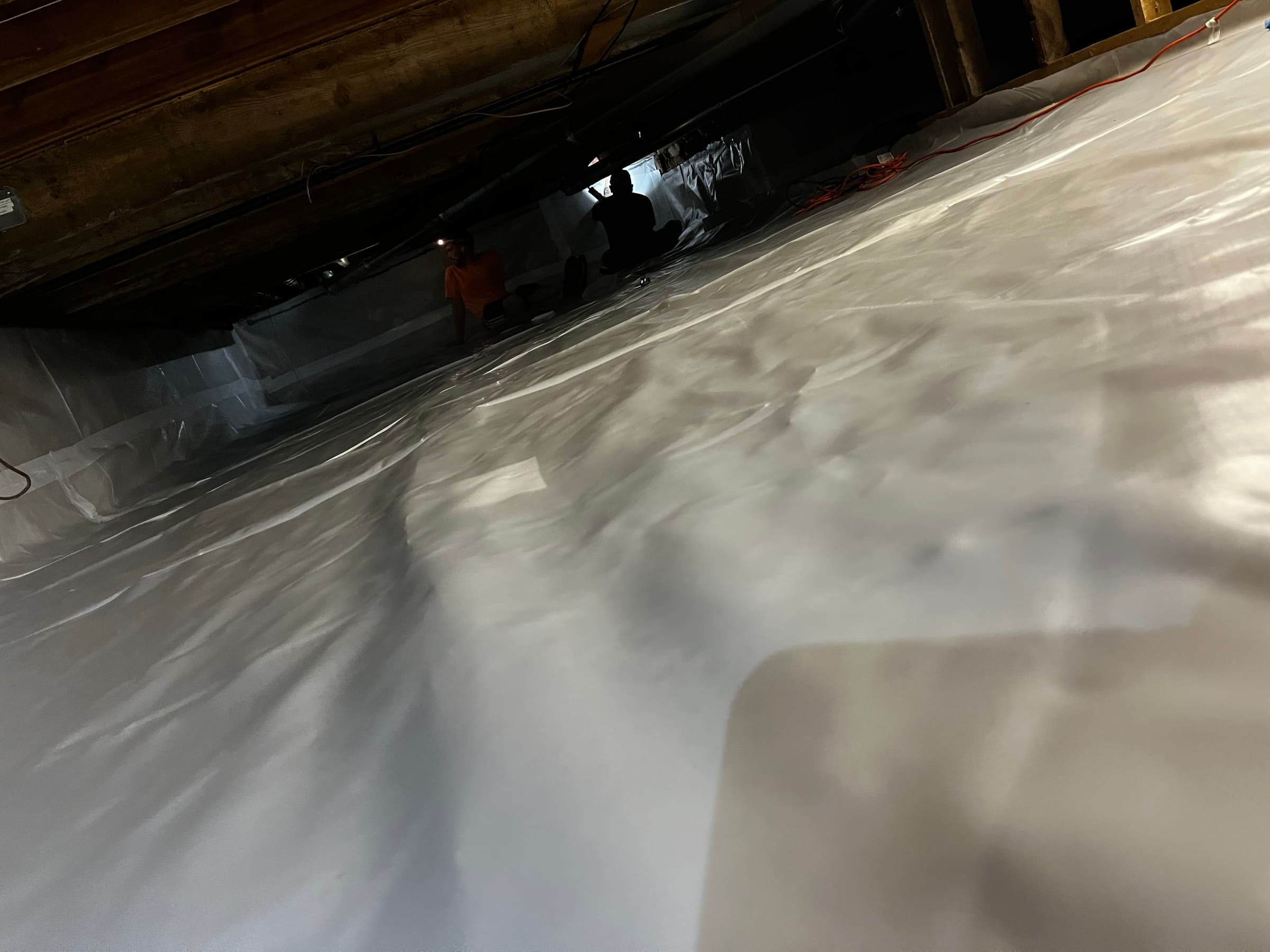
Crawlspace repair across Winnipeg & the Capital Region
Dry, sealed crawlspaces built for Manitoba winters
Encapsulation, moisture control, insulation and structural repair engineered for frost depth, Red River clay and spring melt — not a generic package from a manual.
Book a free inspection
Tell us what you are seeing under the floor. We will come and measure before anyone proposes a scope.
Tell us what you are seeing under the floor — standing water in spring, a musty smell, cold floors, a sloping sunroom — and we will tell you whether it needs attention.
Call or text (431) 446-8587 Email mail@winnipegcrawlspacepros.comServing Winnipeg and surrounding municipalities. Mon–Sat, 7:00 AM – 7:00 PM.
- 1.8–2.4 m
- Local frost depth our systems are detailed for
- 55 %
- Target crawlspace humidity, held year-round
- 57
- Winnipeg neighbourhoods & nearby towns served
Start here
Does any of this sound like your house?
Crawlspace problems rarely announce themselves. They show up as symptoms somewhere else in the house — a smell, a cold floor, a door that sticks in January — and the cause sits in a space nobody visits. If you recognise two or three of these, the space is worth a look.
Book an inspection- A musty smell on the main floor that gets stronger when the furnace runs
- Floors above an addition or sunroom that stay cold all winter
- Frost or water droplets on the underside of the subfloor in January
- Standing water or damp soil in the crawlspace during spring melt
- A sunroom floor that has started to slope, with doors that bind seasonally
- Fibreglass insulation hanging down or lying on the crawlspace floor
- Mice appearing in the house every autumn
- Higher heating bills than neighbours with similar houses
What we do
Fourteen services, one sequence that works
Most crawlspaces need two or three of these, in a particular order. Sealing before drainage, or insulating before the water is managed, is how a project fails in its third winter.
- 01 Crawlspace Encapsulation Seal the space off from soil moisture, soil gas and outside air, then keep it conditioned year-round. Details
- 02 Vapour Barrier Installation The sealed membrane that stops ground moisture and soil gas from entering your home. Details
- 03 Mould Remediation Safe removal of mould growth in crawlspaces, with the moisture source corrected so it does not return. Details
- 04 Crawlspace Insulation Perimeter wall insulation detailed for Manitoba winters, not batts falling out of the floor joists. Details
- 05 Rodent Proofing & Pest Exclusion Sealing the entry points mice and other pests use to get under your floor, and cleaning up what they left. Details
- 06 Sump Pump Installation Pumps and discharge lines specified for spring melt volume and winter freeze resistance. Details
- 07 Drainage Solutions Interior and exterior drainage designed for clay that does not absorb water and melt that arrives all at once. Details
- 08 Crawlspace Leak Repair & Waterproofing Finding and sealing the specific cracks, joints and penetrations where water enters your crawlspace. Details
- 09 Inspection & Assessment A documented assessment with moisture readings and photographs, before anyone proposes a scope of work. Details
- 10 Dehumidifier Installation Properly sized, permanently drained humidity control for a sealed crawlspace. Details
- 11 Structural Support & Jack Posts Correcting sagging beams, tipped piers and support that was never founded below frost depth. Details
- 12 Radon Mitigation Testing and active mitigation for a province with some of the highest indoor radon levels in Canada. Details
- 13 Crawlspace Cleanup & Debris Removal Clearing out construction debris, failed insulation, rodent contamination and decades of stored material. Details
- 14 Emergency Crawlspace Response Urgent response for flooded crawlspaces, burst lines and spring melt water under your floor. Details
Why Manitoba is its own problem
The four conditions every system here has to survive
Crawlspace advice written for Vancouver or Toronto does not transfer to Winnipeg. We are not fighting persistent rain; we are fighting a hard freeze, ground that moves, and a melt that delivers a winter's worth of water in two weeks.
- 1.8–2.4 m Design frost depth
- Support founded above the frost line lifts every winter and settles every spring. It is the single most common structural fault we find under Winnipeg additions.
- 520 mm Annual precipitation
- Low on paper, but it arrives as a fast melt onto frozen ground and as summer downpours on clay that cannot absorb them. Volume is not the problem; timing is.
- Lake Agassiz clay What we build on
- Highly plastic clay that swells when wet and shrinks when dry, working foundation walls and piers through a wide seasonal range every single year.
- 200 Bq/m³ Radon guideline
- Health Canada's action level. Manitoba records some of the highest indoor readings in the country, and an open crawlspace floor is the most direct entry route.
How a project runs
Six steps, in this order
The order matters more than any individual product. Nearly every failed crawlspace we are called to inspect was sealed before its water problem was solved.
(431) 446-8587- 01
Inspection and readings
We go into the space, not just look through the hatch. Moisture content in joists, sills, beams and sheathing; humidity and temperature; founding depth where it can be established; bearing at posts and piers; and where water actually arrives. You get it in writing with photographs.
- 02
Water first, always
If liquid water is entering, it gets a managed exit before anything is sealed. That usually starts outside with grading, downspouts and snow storage, then interior drainage and a properly discharged sump where groundwater warrants it.
- 03
Structure before sealing
Piers that have been cycling with frost get underpinned or replaced below frost depth. Sill plates and post bases with section loss are repaired. There is no sense sealing a space and then cutting the barrier open to fix a beam.
- 04
Clear out and clean
Failed insulation, construction debris, rodent contamination and decades of stored material come out, with protective equipment and HEPA vacuuming where contamination requires it. Only then is the structure fully visible.
- 05
Seal and insulate
Reinforced membrane across the floor and up the walls, mechanically fastened and sealed at every seam and penetration. Vents sealed. Insulation moved to the perimeter walls and rim joist so the space joins the heated envelope.
- 06
Condition and verify
Humidity held near 50 to 55 percent with a permanently drained dehumidifier or conditioned air. Then we measure again — framing moisture and humidity — so the result is documented rather than assumed, and retest radon where mitigation was installed.
Methods
What good crawlspace work looks like
The details below are what separate a system that holds for decades from one that fails in its third winter. These are photographs from our own jobs.
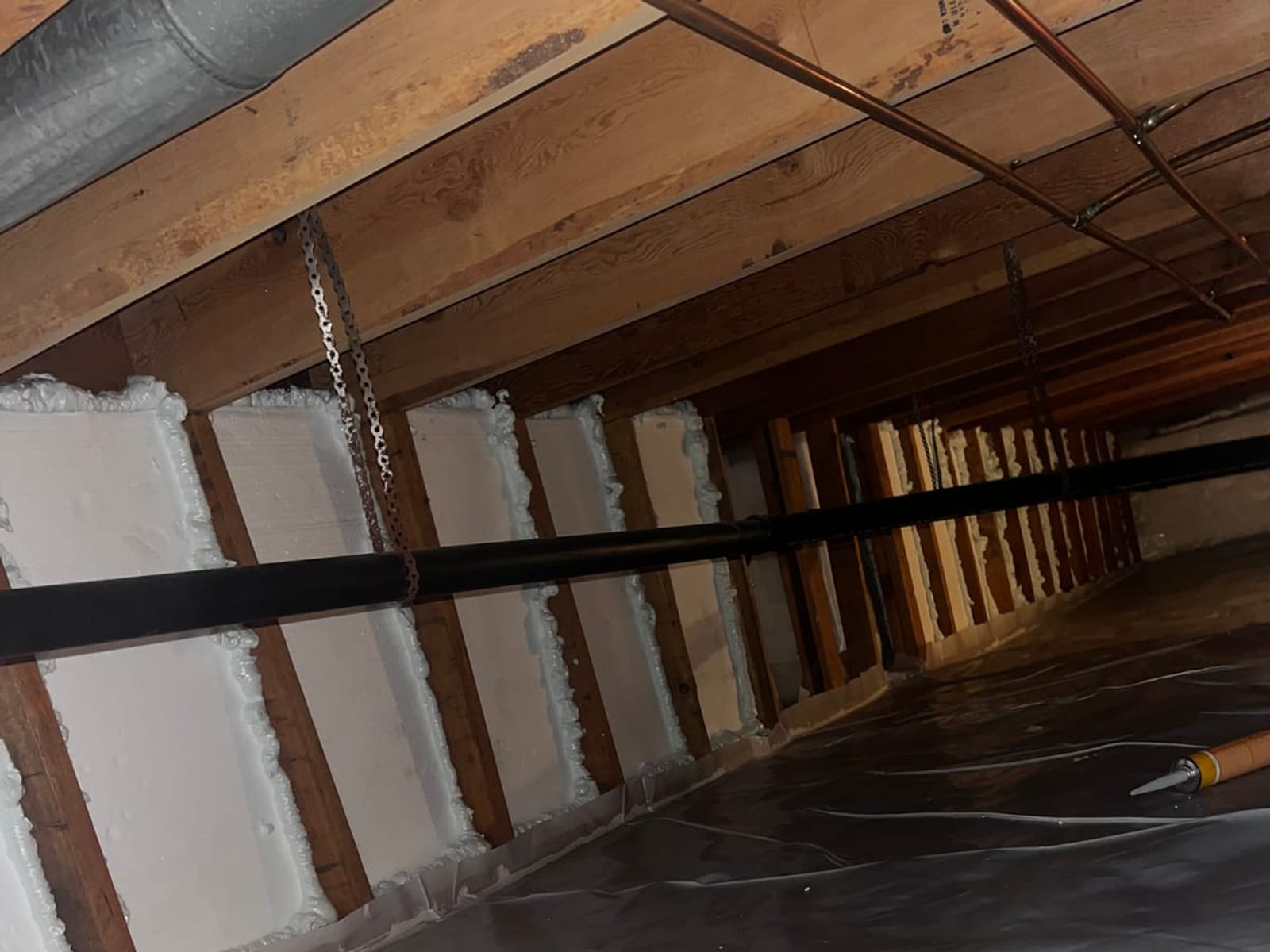
Rim joist sealed, barrier down
Rigid foam cut to each joist bay at the rim and foamed around every edge, with the floor membrane run up to meet it. The rim joist is where most of the heat and most of the winter moisture leave a Winnipeg crawlspace, and it is the part a vapour barrier alone never fixes.
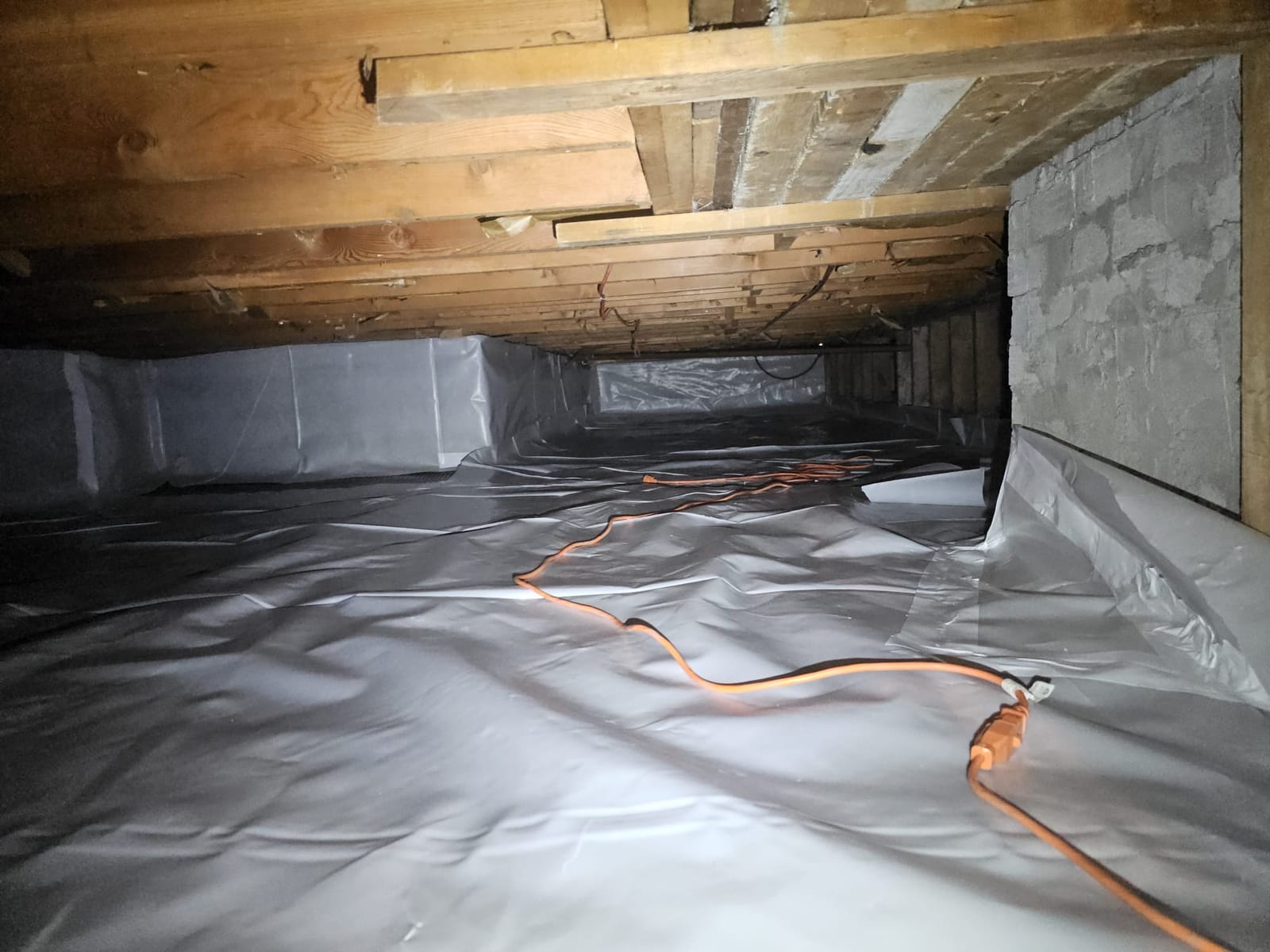
Membrane carried up the foundation wall
The barrier does not stop at the soil — it turns up the block and is terminated against the wall. Left loose at the perimeter, moisture simply travels around the edge and the floor membrane becomes decorative.
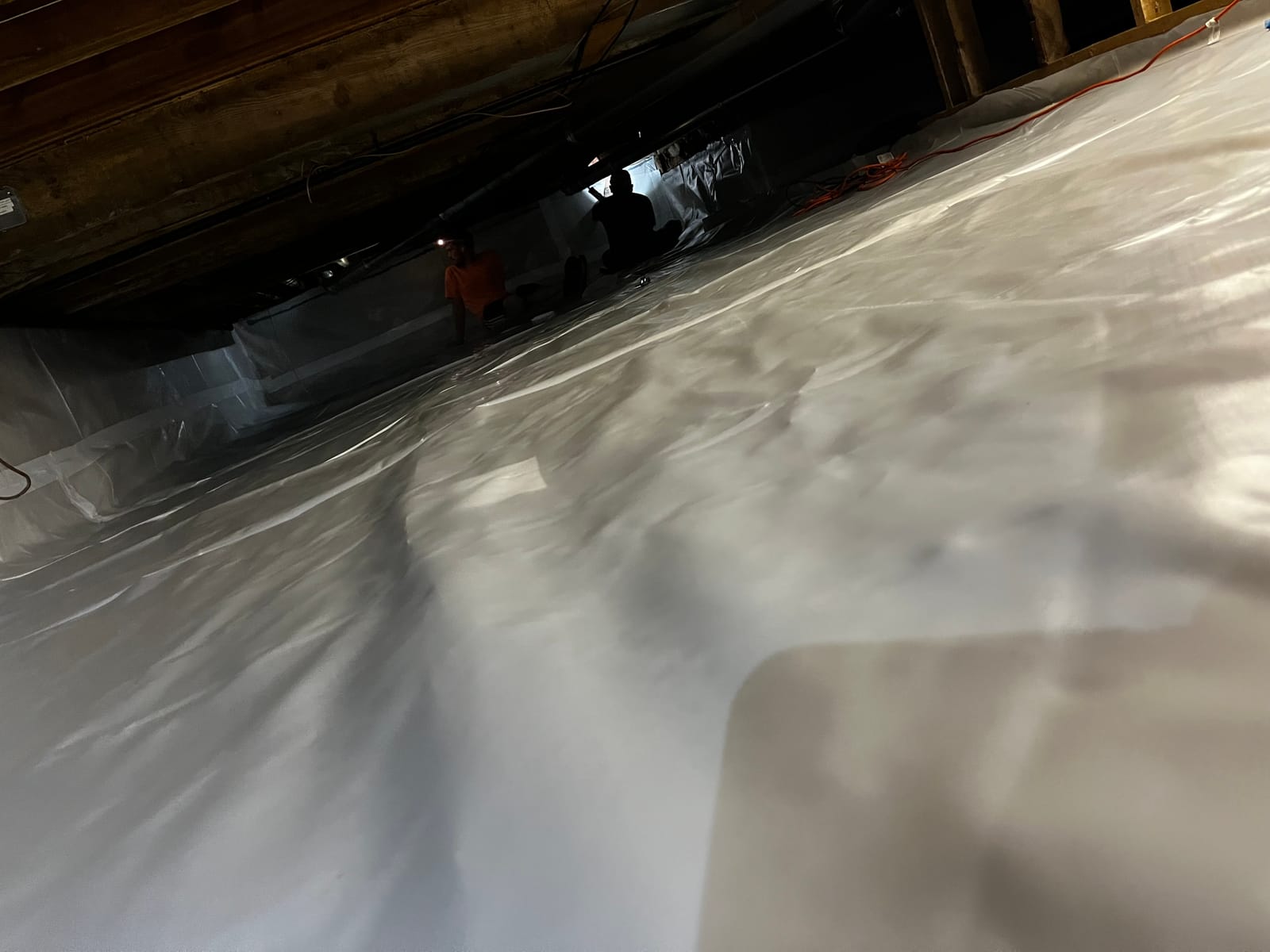
Laying the floor membrane
Sheet being positioned across the full footprint before seaming. Overlaps are run in the direction water would travel and sealed on both faces, so the finished floor is one continuous plane rather than a set of panels.
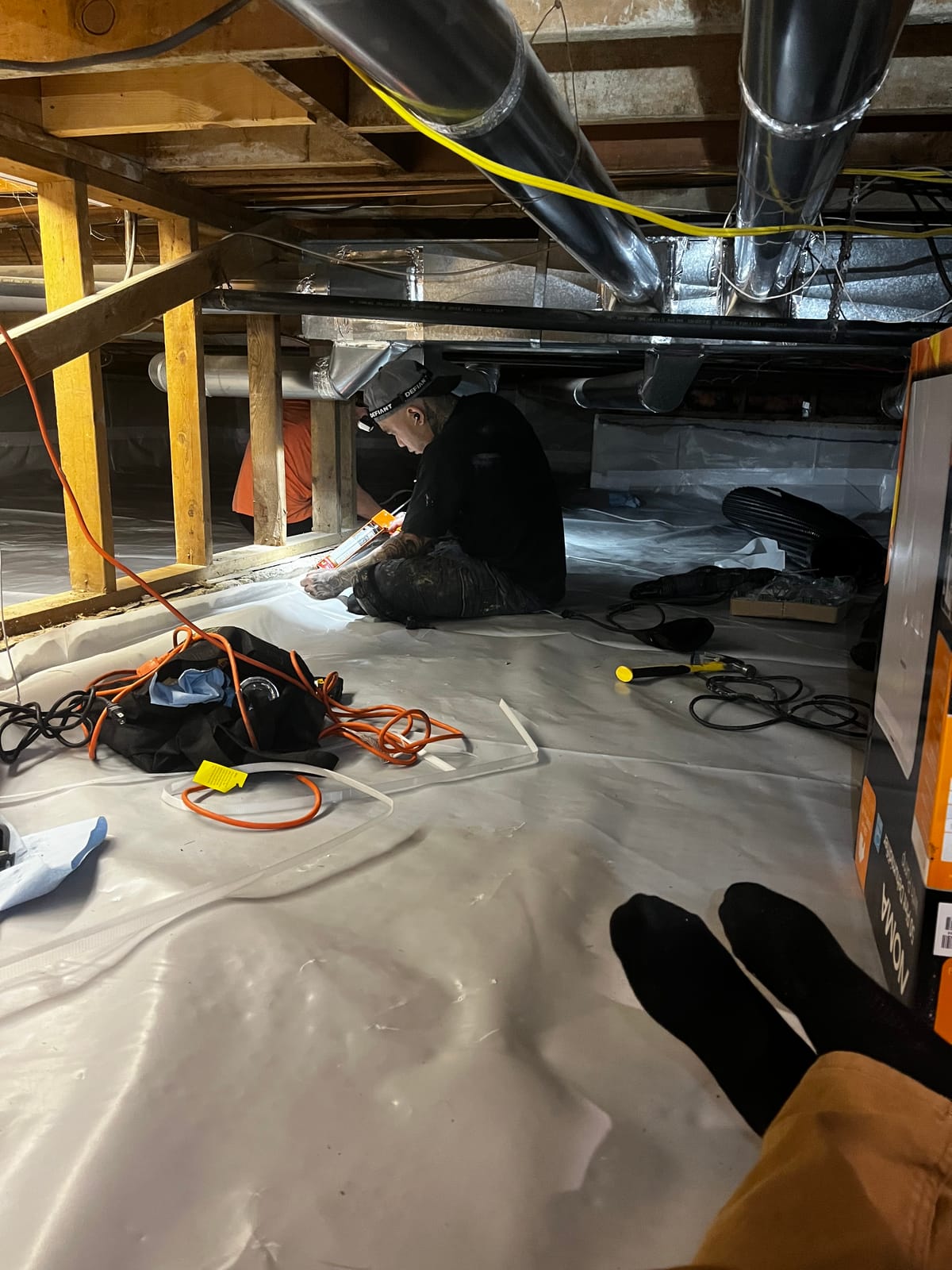
Sealing penetrations by hand
Every pipe, duct and wire that passes through the envelope gets sealed individually. This is slow, unglamorous work done on your back in the dark, and it is the difference between a sealed crawlspace and a mostly sealed one.
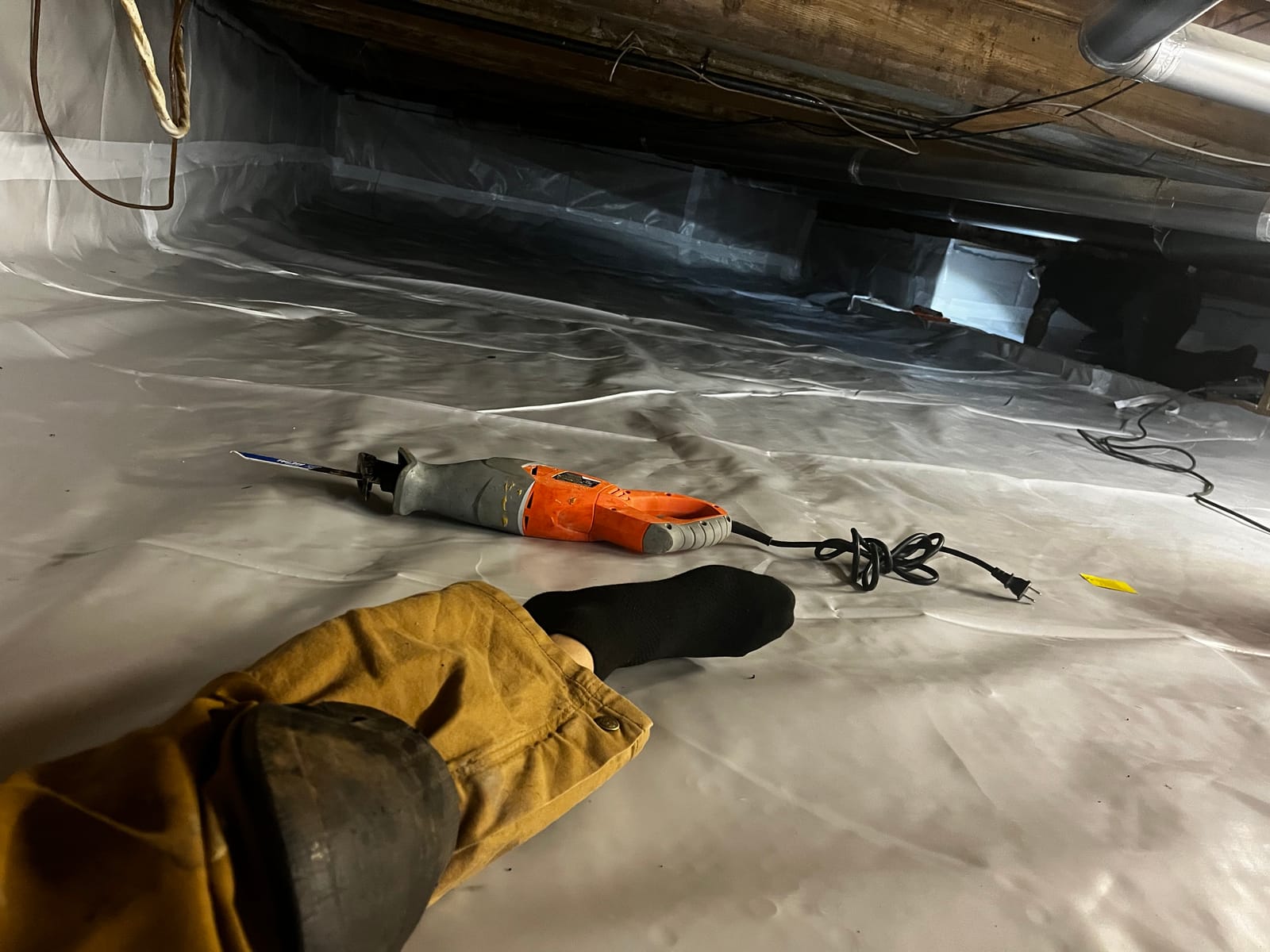
Cutting to fit around obstructions
Membrane trimmed in place around framing and services rather than forced over them. A barrier stretched tight across an obstruction tears at that point within a season or two.
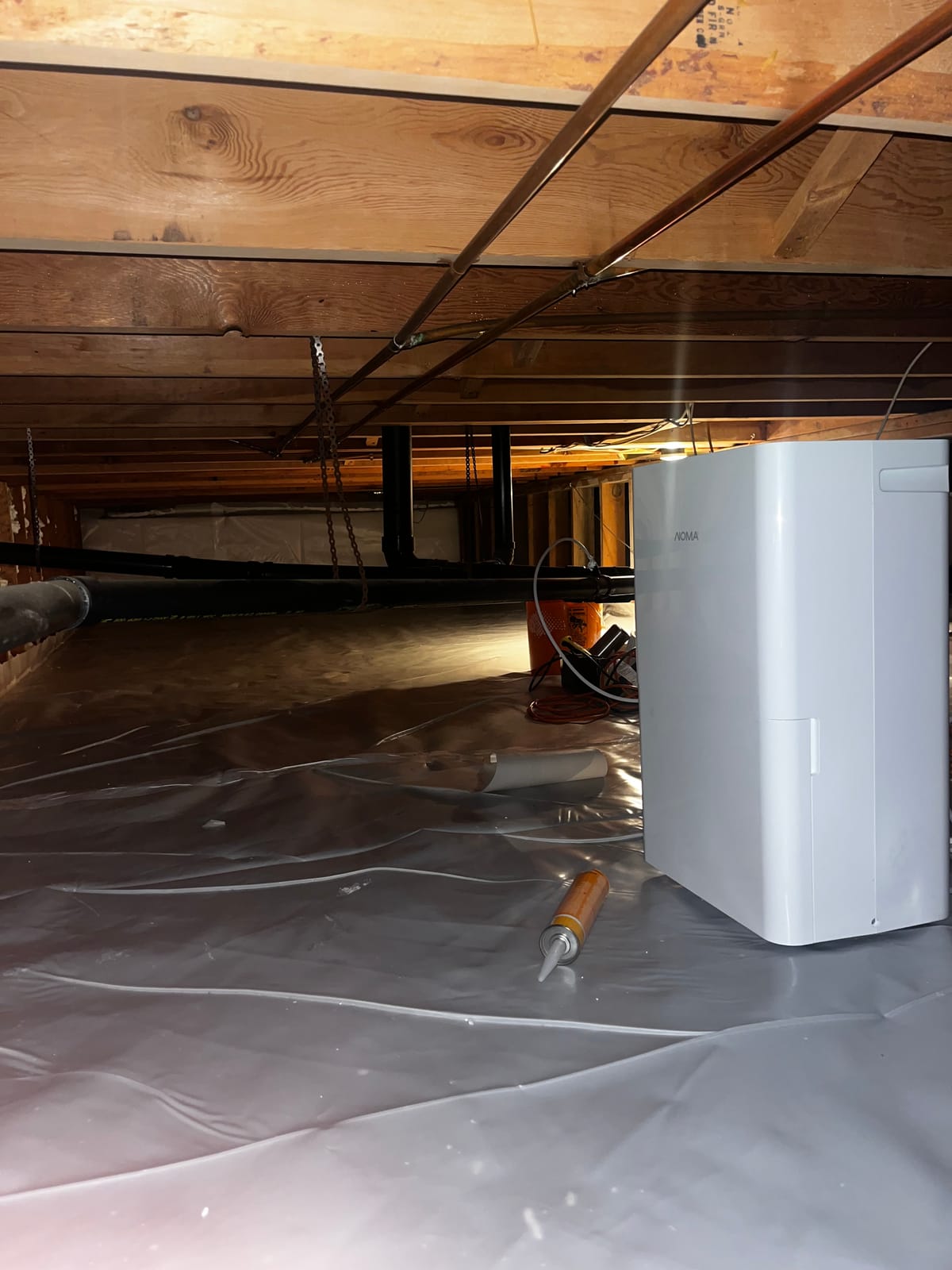
Dehumidifier set on the finished barrier
Once the space is sealed it needs a way to hold humidity down — in Manitoba the target is roughly 55 % year-round. The unit sits on the completed membrane with its drain routed out, not emptied by hand into a bucket nobody checks in February.
On site
A finished crawlspace, start to end of the span
Seven seconds, no narration: the floor membrane run wall to wall under a work light, carried up the perimeter and sealed around the framing. This is what you should be able to see when the work is done — a continuous surface you could lie on, not a patchwork of sheets held down by whatever was to hand.
The case for looking
Why a crawlspace matters more than its size suggests
The space under your floor is not sealed off from the rooms above it. Air moves between the two continuously, through gaps in the subfloor, around plumbing and electrical penetrations, through duct chases and along the rim joist. During our long heating season, the stack effect gives that movement a consistent direction: air enters low in the house and leaves high, which means crawlspace air is being drawn upward into your living space for months at a time. Whatever is in that air — moisture, mould spores, rodent waste, radon — comes with it.
That is the part homeowners here tend to find surprising, because a Winnipeg crawlspace does not feel like a humid place. For most of the winter it is not. The problem is that an unconditioned crawlspace spends the year swinging between two destructive states. In January it runs close to outdoor temperature, so warm, moist indoor air moving down into it condenses and freezes on the cold underside of the subfloor and on the rim joists. In July the direction reverses: humid outdoor air comes in through open vents, meets soil and framing that are still cool, and condenses there instead. Either way, wood that holds moisture above roughly 19 percent is wood that decay organisms and mould can use.
The structural side runs in parallel. Our design frost depth is roughly 1.8 to 2.4 metres, and the Lake Agassiz clay under most of the city is highly plastic — it swells when it takes on water and shrinks when it dries. Anything founded above the frost line gets lifted every winter and dropped every spring. Crawlspace additions built on shallow sonotube piers, which is most of them, move on that cycle for decades. The sloping sunroom floor and the patio door that binds in January are not cosmetic complaints; they are the visible end of a support problem under the floor.
None of this is unfixable, and none of it requires guesswork. A crawlspace that has been sealed properly, insulated at the perimeter rather than between the joists, drained where water actually arrives, and supported below frost depth will hold a stable humidity through both the melt and the August peak. The framing dries out and stays dry. The floor above stops being cold. The smell goes away because its source is gone. And the house stops losing heat to a space that was, in effect, outdoors.
What we will not do is sell you a system you do not need. Plenty of the crawlspaces we inspect need nothing more than longer downspout extensions, better grading away from the wall, and another reading next spring. If that is what we find, that is what we will tell you — in writing, with the numbers we measured, so you can judge it yourself.
Where we work
Winnipeg, plus 18 surrounding municipalities
Conditions change across the region — limestone close to the surface at Stonewall, sandier ground at Steinbach, river-driven groundwater at Selkirk and St. Adolphe, dense clay almost everywhere else. The pages below cover what we actually find in each.
- Winnipeg
- Headingley
- East St. Paul
- West St. Paul
- St. Andrews
- Selkirk
- Stonewall
- Stony Mountain
- Oakbank
- Dugald
- Beausejour
- Lorette
- Île-des-Chênes
- St. Adolphe
- Niverville
- Steinbach
- Landmark
- La Salle
- Grande Pointe
Winnipeg neighbourhoods
River Heights · Crescentwood · Tuxedo · Wolseley · West Broadway · Osborne Village · Fort Rouge · Lord Roberts · Riverview · St. Vital · Norwood · St. Boniface · Windsor Park · Southdale · Island Lakes · Royalwood · Sage Creek · St. Norbert · Fort Richmond · Fort Garry · Linden Woods · Whyte Ridge · Bridgwater · Waverley West · Charleswood · Westwood · Crestview · Silver Heights · St. James · North Kildonan · East Kildonan · Elmwood · Transcona · West Kildonan · Garden City · The Maples · Point Douglas · Tyndall Park
Request an inspection
Winnipeg and surrounding municipalities. We will tell you if it needs nothing.
Tell us what you are seeing under the floor — standing water in spring, a musty smell, cold floors, a sloping sunroom — and we will tell you whether it needs attention.
Call or text (431) 446-8587 Email mail@winnipegcrawlspacepros.comServing Winnipeg and surrounding municipalities. Mon–Sat, 7:00 AM – 7:00 PM.
Prefer to talk it through? Call or text and we will tell you whether what you are seeing needs attention.